


11th Annual Pediatric and Neonatal Critical Care Transport Team Conference (5/09/2026)
Course Credit
The following credits are available for this course:
| Contact Hours (Nurse) | 7.5 hours |
| General Attendance | 7.5 hours |
For EMS Credit: At the conclusion of the conference, please complete the quiz here: https://www.surveymonkey.com/r/QBLWZJX. Participants will receive an additional email with their continuing education certificate 48 hours after completing the REQUIRED post-conference exam.
Overview
This course provides clinicians with the latest evidence-based recommendations and innovations in pediatric healthcare needed to care for the critically ill child during inter-facility transport and throughout hospitalization. Presented by highly skilled practitioners and content experts in Critical Care Medicine, Emergency Medicine and Pediatric Transport. The course is formatted to engage learners through virtual instructor led lectures and Q&A with presenters.
Course Format
This course will be fully virtual and presented via Zoom.
Learning Objectives:
At the conclusion of this educational program, learners will be able to:
- Discuss pre-hospital care and traumatic arrest of the pediatric trauma patient
- Describe presentation and management of hypoxic-ischemic encephalopathy (HIE)
- Discuss the complexities of airway management in the patient with a new mediastinal mass
- Outline key points of post-cardiac arrest care in pediatrics
- Review the pathophysiology and treatment of cannabis hyperemesis syndrome (CHS)
- Differentiate between respiratory distress and heart failure in the pediatric population
- Describe the history, challenges, and major innovations of military critical care air transport
- Identify key points in the care of critically ill pediatric/neonatal patients during inter-facility transport

In support of improving patient care, Boston Children’s Hospital is jointly accredited by the Accreditation Council for Continuing Medical Education (ACCME), the Accreditation Council for Pharmacy Education (ACPE), and the American Nurses Credentialing Center (ANCC), to provide continuing education for the healthcare team.
Nurse
Boston Children’s Hospital designates this activity for 7.5 contact hours for nurses. Nurses should only claim credit commensurate with the extent of their participation in the activity.
Emergency Service
Approved for 7.5 continuing education hours (Basic, Advanced, Paramedic levels) by Region IV of the Metropolitan Boston Emergency Medical Services Council. *in accordance with the Office of Emergency Medical Services (OEMS) requirements, all levels of EMT are required to complete and end-of-course examination.
|
|
|||
|---|---|---|---|
 Sarah Smith McAlvin, PhD, CPNP, CCRN, EMT
Staff Nurse III, Critical Care Transport Program, Boston Children’s Hospital
Sarah Smith McAlvin, PhD, CPNP, CCRN, EMT
Staff Nurse III, Critical Care Transport Program, Boston Children’s Hospital
|
|||
 Joanathan Levin, MD, MBI
Director, Bronchopulmonary Dysplasia Program; Director, Center for Healthy Infant Lung Development; Co-Director, Chronic Pulmonary and Ventilator Program; Pulmonologist, Divisions of Newborn Medicine and Pulmonary Medicine, Boston Children’s Hospital
Assistant Professor of Pediatrics, Harvard Medical School Joanathan Levin, MD, MBI
Director, Bronchopulmonary Dysplasia Program; Director, Center for Healthy Infant Lung Development; Co-Director, Chronic Pulmonary and Ventilator Program; Pulmonologist, Divisions of Newborn Medicine and Pulmonary Medicine, Boston Children’s Hospital
Assistant Professor of Pediatrics, Harvard Medical School
|
|||
 Paul Guarino, BSN, RN, NREMT-P
Trauma Center Educator, Quality Improvement Coordinator
Department of General Surgery, Trauma Center, Boston Children’s Hospital Paul Guarino, BSN, RN, NREMT-P
Trauma Center Educator, Quality Improvement Coordinator
Department of General Surgery, Trauma Center, Boston Children’s Hospital
|
|||
 Brian Kalish, MD
Assistant Medical Director, Critical Care Transport Program
Physician in Medicine, Division of Newborn Medicine, Boston Children’s Hospital
Assistant Professor of Pediatrics, Harvard Medical School
Brian Kalish, MD
Assistant Medical Director, Critical Care Transport Program
Physician in Medicine, Division of Newborn Medicine, Boston Children’s Hospital
Assistant Professor of Pediatrics, Harvard Medical School
|
|||
 Shawn Jackson, MD
Assistant Medical Director, Critical Care Transport Program
Department of Anesthesiology, Pediatric Anesthesiology Fellowship, Boston Children’s Hospital
Pediatric Residency: Anesthesiology Residency, Brigham and Women’s Hospital Shawn Jackson, MD
Assistant Medical Director, Critical Care Transport Program
Department of Anesthesiology, Pediatric Anesthesiology Fellowship, Boston Children’s Hospital
Pediatric Residency: Anesthesiology Residency, Brigham and Women’s Hospital
|
|||
 Monica E. Kleinman, MD Monica E. Kleinman, MDAssistant Medical Director, Critical Care Transport Program, Chief Safety Officer, Program for Patient Safety and Quality, Co-Chair, Resuscitation Quality Program, Associate Chief, Division of Critical Care Medicine, Department of Anesthesiology, Critical Care and Pain Medicine
Associate Professor of Anesthesia (Pediatrics), Harvard Medical School |
|||
 Michael S. Toce, MS, MD
Associate Physician in Pediatrics
Division of Emergency Medicine and Medical Toxicology, Boston Children’s Hospital
Assistant Professor of Pediatrics, Harvard Medical School
Michael S. Toce, MS, MD
Associate Physician in Pediatrics
Division of Emergency Medicine and Medical Toxicology, Boston Children’s Hospital
Assistant Professor of Pediatrics, Harvard Medical School
|
|||
 Jason S. Kerstein, MD
Critical Care Fellow
Division of Cardiology, Boston Children’s Hospital Jason S. Kerstein, MD
Critical Care Fellow
Division of Cardiology, Boston Children’s Hospital
|
|||
 Ashley Sam, DO, FAAP
Attending Physician
Pediatric Intensive Care Unit, St. Louis Children’s Hospital Ashley Sam, DO, FAAP
Attending Physician
Pediatric Intensive Care Unit, St. Louis Children’s Hospital
|
|||
 Jordan Rettig, MD
Medical Director, Critical Care Transport Program
Associate, Division of Critical Care Medicine, Boston Children’s Hospital
Department of Anesthesiology, Critical Care and Pain Medicine
Instructor of Anesthesia, Harvard Medical School
Pediatric Medical Director, Boston MedFlight
Jordan Rettig, MD
Medical Director, Critical Care Transport Program
Associate, Division of Critical Care Medicine, Boston Children’s Hospital
Department of Anesthesiology, Critical Care and Pain Medicine
Instructor of Anesthesia, Harvard Medical School
Pediatric Medical Director, Boston MedFlight
|
|||


| Saturday, May 9, 2026 | ||
|---|---|---|
| Welcome and Introduction 8:00 AM – 8:05 AM Sarah Smith McAlvin, PhD, RN, CPNP | ||
Strategies to Manage Bronchopulmonary Dysplasia
8:05 AM – 8:55 AM
Jonathan Levin, MD
|
||
Pediatric Trauma Arrest: Lessons Learned, Paradigms Challenged
8:55 AM – 9:45 AM
Paul Guarino, RN
|
||
| Break 9:45 AM – 10:00 AM | ||
Neonatal Brain Injury: Challenges and Controversies
10:00 AM – 10:45 AM
Brian Kalish, MD
|
||
Airway Considerations for the New Mediastinal Mass
10:45 AM – 11:30 AM
Shawn Jackson, MD
|
||
Pediatric Post-cardiac Arrest Care
11:30 AM – 12:15 PM
Monica E. Kleinman, MD
|
||
| Lunch 12:15 PM – 12:45 PM | ||
Cannabis Hyperemesis Syndrome
12:45 PM – 1:30 PM
Michael Toce, MD
|
||
Respiratory Disease vs. Heart Failure
1:30 PM – 2:15 PM
Jason Kerstein, MD
|
||
| Break 2:15 PM – 2:30 PM | ||
Military Critical Care Air Transport
2:30 PM – 3:15 PM
Ashley Sam, DO
|
||
Transport Case Reviews
3:15 PM – 4:20 PM
Jordan Rettig, MD
|
||
| Closing Comments/Q&A/Evaluations 4:20 PM – 4:30 PM Jennifer McNamara, RN | ||
Disclosures
Boston Children’s Hospital adheres to all ACCME Essential Areas, Standards, and Policies. It is Boston Children’s policy that those who have influenced the content of a CME activity (e.g. planners, faculty, authors, reviewers and others) disclose all relevant financial relationships with commercial entities so that Boston Children’s may identify and resolve any conflicts of interest prior to the activity. These disclosures will be provided in the activity materials along with disclosure of any commercial support received for the activity. Additionally, faculty members have been instructed to disclose any limitations of data and unlabeled or investigational uses of products during their presentations.
The following planners, speakers, and content reviewers, on behalf of themselves, do not have any relevant financial relationships with any entity producing, marketing, reselling, or distributing health care goods or services consumed by, or used on patients:
| Sarah Smith McAlvin, RN | Ashley Sam, DO |
| Jonathan Levin, MD | Jordan Rettig, MD |
| Paul Guarino, RN | Jennifer McNamara, RN |
| Brian Kalish, MD | Christine Fannon |
| Shawn Jackson MD | |
| Michael Toce, MD | |
| Jason Kerstein, MD |
The following planners, speakers, and content reviewers, on behalf of themselves, have reported the following relevant financial relationships with any entity producing, marketing, reselling, or distributing health care goods or services consumed by, or used on patients:
| Monica E. Kleinman, MD | American Heart Association: Consultant Boston MedFlight: Advisor |
Please see the FAQs below for common questions about how to work through a course. If you have a question or issue that is not addressed in the FAQ, please use this form to submit a help request, or if your issue is urgent, call the CME office at: 617-919-9908.
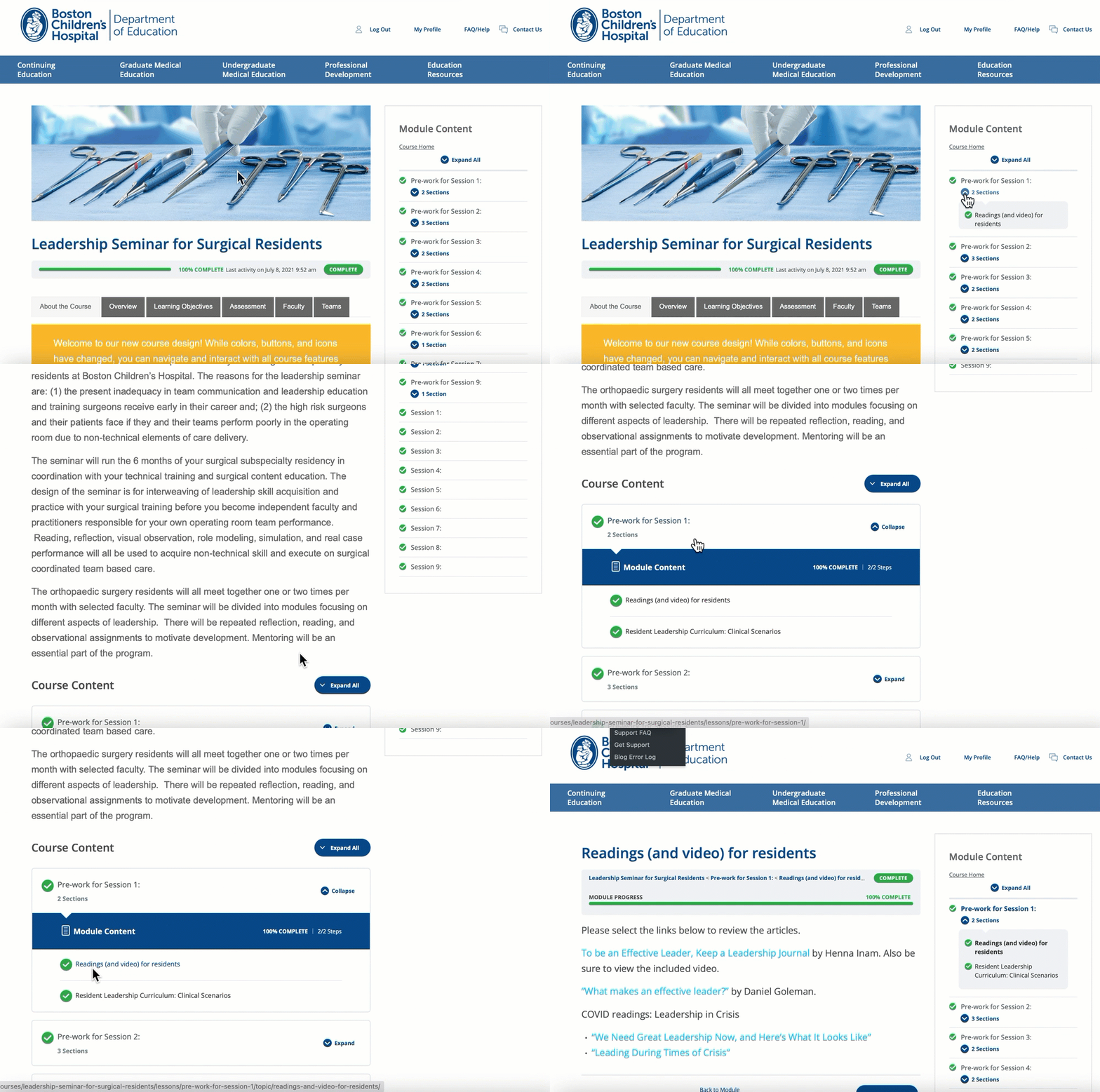
How do I navigate this course? There are two ways to access and navigate course content with the interactive table of contents: at the bottom of the main course page or in the sidebar on the right side of the page. Select the links in the table of contents to access the corresponding content. Depending on the course, access to content may be linear, in which case each content module or section can only be accessed if the prior ones are completed, or non-linear, in which case modules and sections can be accessed in any order. Use the breadcrumbs at the top of any course page to orient yourself within a course, or return to a previous course section or the main course page. How do I claim credit? If the course has been accredited, available credits will be displayed on the course home page. Select only those credits that apply to your profession, and click/tap “Apply Selection.” You may make your selection at any point while you are taking the course, or after you have completed it. How do I download a certificate? There are two ways to view/download your certificate: from within the course or from the course listing under your profile (select the document icon). In either case, you must have selected at least one available course credit type to generate a certificate. How do I view/print my transcript? You must be logged in to view your transcript. Select My Profile at the top of the page. If you do not see the transcript selector, be sure the Courses tab is selected. Select the type of credit and dates to include in your credit report. To include all credits from all time, leave the options blank. Select Download Transcript to view/download your transcript. Note each credit type in your transcripts starts a new page. How do I request a refund? Please email the CME Department to request a refund.How do navigate this course?
How do I claim credit for this course?
How do I download a certificate?
How do I view/print my transcript?
How do I request a refund?