

Emergent and Urgent Asthma – Clinical Pathways Podcast
Current Status
Price
Get Started
Course Credit
The following credits are available for this course:
| AMA PRA Category 1 Credits™ (MD, DO, NP, PA) | 0.5 hours |
| Contact Hours (Nurse) | 0.5 hours |
| American Academy of Physician Assistants (AAPA) Category 1 CME Credits | 0.5 hours |
| CPE Credits (Pharmacist) | 0.5 hours |
| General Attendance | 0.5 hours |
(Note: a course evaluation is required to receive credit for this course.)

Kyle Nelson, MD, MPH
Associate Physician in Pediatrics, Division of Emergency Medicine, Boston Children’s Hospital
Assistant Professor of Pediatrics and Emergency Medicine, Harvard Medical School

Moderator: Miya Bernson-Leung, MD, EdM
Program Director, Child Neurology Residency Training Program, Boston Children’s Hospital
Medical Director of Continuing Education, Center for Educational Excellence and Innovation, Boston Children’s Hospital
Assistant Professor of Neurology, Harvard Medical School
This episode of the Boston Children’s Hospital Clinical Pathways Podcast reviews the Emergent and Urgent Asthma pathway, focused on improving consistency and quality of care for children presenting with asthma exacerbations. The discussion highlights the importance of early severity assessment, prompt administration of systemic steroids, efficient use of bronchodilators and adjunctive therapies, and avoidance of unnecessary testing. Emphasis is placed on interprofessional collaboration and aligning emergency care with inpatient and outpatient asthma management guidelines to improve patient outcomes.
Clinical Pathways are educational reference tools developed by Boston Children’s Hospital clinicians which focus on the diagnosis and management of a wide variety of clinical conditions based on up-to-date evidence and expert practice. On this show, host Miya Bernson-Leung, MD, EdM, Medical Director of Continuing Education and a member of the Clinical Pathways Advisory Committee, interviews clinical experts to take you behind each pathway, discussing why the pathway was developed and key takeaways for clinicians seeking to implement the pathway and provide safe, effective, evidence-based care to children. You can find the full library at https://clinical.pathways.childrenshospital.org/.
Any treatment and/or medication recommendations within the pathway is provided for educational reference only, it is not intended as medical advice for individual patient care. Decisions about evaluation, diagnosis, and/or treatment are the responsibility of the patient’s treating clinician and should always be tailored to the individual patient’s clinical care needs.
Learning Objectives:
At the conclusion of this educational program, learners will be able to:
- Apply a standardized, severity-based approach to the management of pediatric asthma exacerbations in emergent and urgent care settings, including assessment using a validated clinical severity score.
- Recognize key evidence-based interventions that reduce variability in acute asthma care, such as timely systemic corticosteroid administration, appropriate use of adjunctive therapies, and judicious diagnostic testing.

In support of improving patient care, Boston Children’s Hospital is jointly accredited by the Accreditation Council for Continuing Medical Education (ACCME), the Accreditation Council for Pharmacy Education (ACPE), and the American Nurses Credentialing Center (ANCC), to provide continuing education for the healthcare team.
Physician
Boston Children’s Hospital designates this live activity for a maximum of 0.5 AMA PRA Category 1 Credits ™. Physicians should claim only credit commensurate with the extent of their participation in this activity.
Nurse
Boston Children’s Hospital designates this activity for 0.5 contact hours for nurses. Nurses should only claim credit commensurate with the extent of their participation in the activity.
Physician Assistant
Boston Children’s Hospital has been authorized by the American Academy of PAs (AAPA) to award AAPA Category 1 CME credits for activities planned in accordance with AAPA CME Criteria. This activity is designated for 0.5 AAPA Category 1 CME credits. PAs should only claim credit commensurate with the extent of their participation.
Pharmacy
This activity carries a maximum of 0.5 contact hours. Pharmacists should only claim credit commensurate with the extent of their participation in the activity.
Disclosures
Boston Children’s Hospital adheres to all ACCME Essential Areas, Standards, and Policies. It is Boston Children’s policy that those who have influenced the content of a CME activity (e.g. planners, faculty, authors, reviewers and others) disclose all relevant financial relationships with commercial entities so that Boston Children’s may identify and resolve any conflicts of interest prior to the activity. These disclosures will be provided in the activity materials along with disclosure of any commercial support received for the activity. Additionally, faculty members have been instructed to disclose any limitations of data and unlabeled or investigational uses of products during their presentations.
The following planners, speakers, and content reviewers, on behalf of themselves, have reported the following relevant financial relationships with any entity producing, marketing, reselling, or distributing health care goods or services consumed by, or used on patients:
Kyle Nelson, MD, MPH
None
Miya Bernson-Leung, MD, EdM
None
Please see the FAQs below for common questions about how to work through a course. If you have a question or issue that is not addressed in the FAQ, please use this form to submit a help request, or if your issue is urgent, call the CME office at: 617-919-9908.
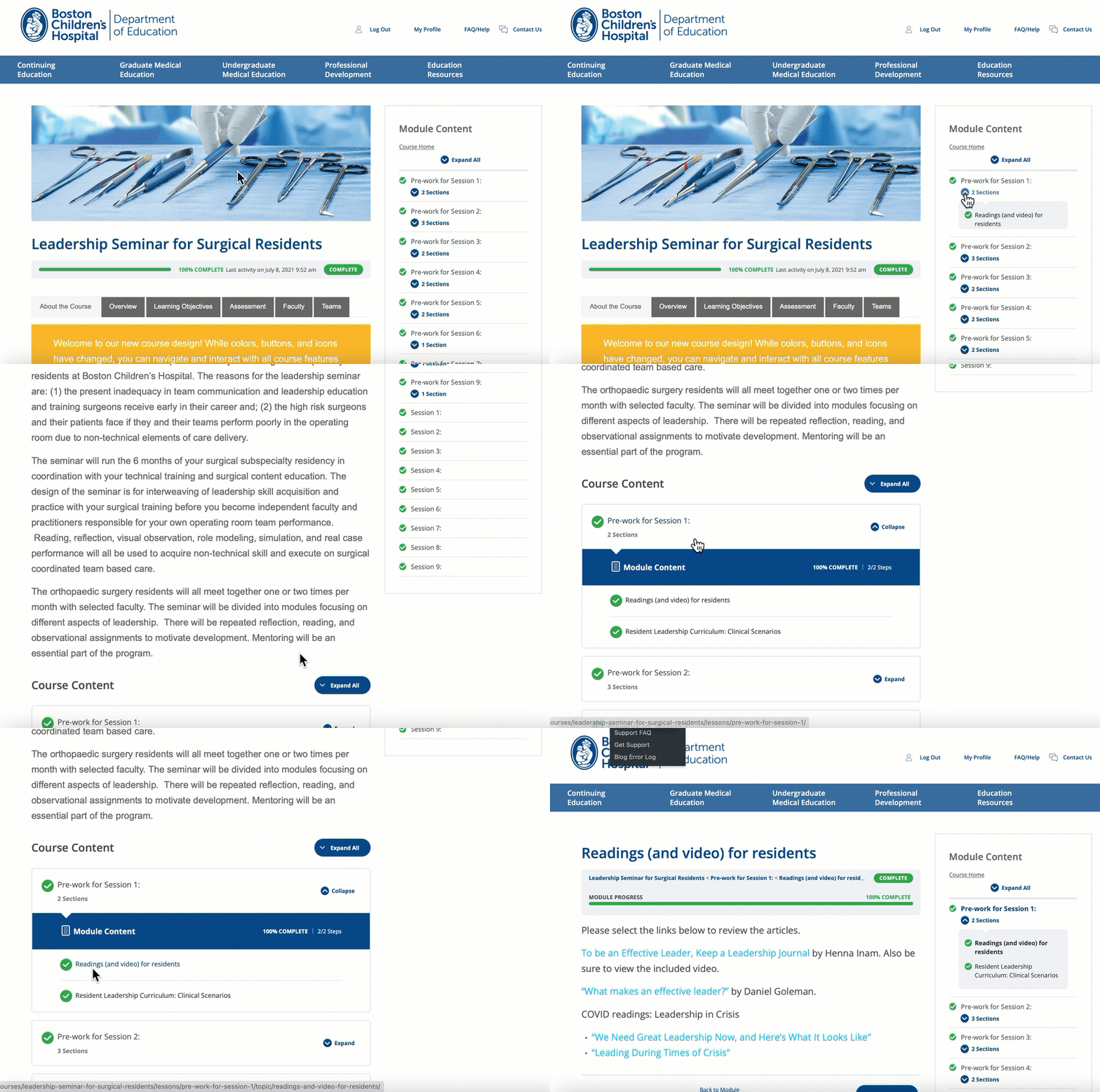
How do I navigate this course? There are two ways to access and navigate course content with the interactive table of contents: at the bottom of the main course page or in the sidebar on the right side of the page. Select the links in the table of contents to access the corresponding content. Depending on the course, access to content may be linear, in which case each content module or section can only be accessed if the prior ones are completed, or non-linear, in which case modules and sections can be accessed in any order. Use the breadcrumbs at the top of any course page to orient yourself within a course, or return to a previous course section or the main course page. How do I claim credit? If the course has been accredited, available credits will be displayed on the course home page. Select only those credits that apply to your profession, and click/tap “Apply Selection.” You may make your selection at any point while you are taking the course, or after you have completed it. How do I download a certificate? There are two ways to view/download your certificate: from within the course or from the course listing under your profile (select the document icon). In either case, you must have selected at least one available course credit type to generate a certificate. How do I view/print my transcript? You must be logged in to view your transcript. Select My Profile at the top of the page. If you do not see the transcript selector, be sure the Courses tab is selected. Select the type of credit and dates to include in your credit report. To include all credits from all time, leave the options blank. Select Download Transcript to view/download your transcript. Note each credit type in your transcripts starts a new page. How do I request a refund? Please email the CME Department to request a refund.How do navigate this course?
How do I claim credit for this course?
How do I download a certificate?
How do I view/print my transcript?
How do I request a refund?
View on Zencastr
Click Here to View Transcript
Miya Bernson-Leung 00:03
Hello and welcome to the Boston Children’s Hospital Clinical Pathways Podcast, a collaboration between the program for Patient Safety and Quality and the Center for Educational Excellence and Innovation. I’m your host, Miya Bernson-Leung, Medical Director of Continuing Education and a member of the Clinical Pathways Committee. Clinical pathways are educational reference tools developed by BCH clinicians based on current available evidence and local practice, which focus on the diagnosis and management of a wide variety of clinical conditions and allow discretion based on clinical judgment. You can access the clinical pathways library, including the pathway we will discuss in today’s episode, at clinical.pathways.childrenshospital.org, or on the BCH Clinical Pathways app for iOS or Android. In this podcast series, a team of moderators and I will interview clinical experts from Boston Children’s Hospital to take you behind the pathways. Why was the pathway developed, and what clinical need or practice problem is it trying to address? What are common knowledge gaps about the pathway’s topic and key takeaways for clinicians seeking to implement the pathway and provide safe, effective, and evidence based care to children. Each episode is accredited for continuing education credits for physicians, PAs, nurses, and pharmacists. To claim credit, go to dme.childrenshospital.org/clinicalpathwayspodcast. We hope you enjoy today’s episode. The moderators and speakers for today’s podcast have no relevant disclosures or financial conflicts of interest. Welcome everyone to this episode of the Clinical Pathways Podcast. This is your host, Miya Bernson-Leun, and the pathway that we will be discussing today is on the topic of asthma, specifically our emergent/urgent pathway. I am very excited to have Dr Kyle Nelson to discuss this pathway with us. Dr Nelson is an associate physician in pediatrics in our Division of Emergency Medicine and an assistant professor of Pediatrics and Emergency Medicine at Harvard Medical School. Welcome, Kyle.
Kyle Nelson 02:09
Thank you for having me, Miya. It’s great to be here.
Miya Bernson-Leung 02:11
Thanks so much for coming. So, asthma is a really common condition among children, really important topic in terms of thinking about how to optimally manage it, and so very glad to have you here. For people who may not have the pathway right in front of them, do you mind giving us a overall summary of what it’s all about?
Kyle Nelson 02:29
Sure. Yeah, asthma is one of the most common chronic childhood conditions, so it’s a frequent reason for emergency visits, healthcare visits, whether it’s the clinic or to the ED well as hospitalizations. So the pathway is designed to outline treatment recommendations based on the severity of symptoms for children with asthma exacerbations, and response to treatment. So we designed it to look at what treatment they received before they got to the ED, whether that was at home or in the office or referring ED, and also to look at the improvement that they have after treatment in the ED. So it was implemented, designed as a team approach, with input from nursing, from MDs, respiratory therapists and pharmacists, and it’s based on experience treating children with asthma, as well as some of the research that’s been done and national guidelines.
Miya Bernson-Leung 03:25
That’s great. It sounds like a really interprofessional effort.
Kyle Nelson 03:28
Yeah, it’s been a team approach over the years, and we’ve been looking and meeting with other asthma providers in the hospital, so inpatient care as well as ICU care, to help to align the pathways as well.
Miya Bernson-Leung 03:39
And how did you personally get involved in this, what’s your what’s your interest in the topic?
Kyle Nelson 03:43
I’ve been involved with asthma research since I was a fellow in pediatric emergency medicine many years ago. It’s really intriguing to work on asthma care, as such a common condition. It’s been exciting to look at aspects of care, quality improvement and clinical pathways like this.
Miya Bernson-Leung 04:00
That’s wonderful. One of the things that you mentioned was, you know, really hoping to improve the quality of care, and thinking about this for a long time as you have, what do you see as the gaps in terms of current care practices, or maybe knowledge gaps or common pitfalls that you’re hoping that this pathway will help to address?
Kyle Nelson 04:19
There’s variability in asthma care. As a common condition, kids are treated in children’s hospital EDs like ours, as well as general EDs around the country. In fact, the majority of children treated in EDs are treated in general EDs that aren’t freestanding children’s hospitals like Boston Children’s. So we look at some of the variability in care and some of the important aspects, and one of them is systemic corticosteroids. Those are important in asthma exacerbation management, they’re proven effective to help reduce hospitalization rates, relapse visit rates, as well as improving symptoms in general. So we do see there is a gap in some of the care that’s received, so some children are not receiving the steroids for exacerbations when they should. So our pathway recommends giving the steroids, and in fact, giving steroids as soon as possible after arrival. The sooner the better, as we say. If you give the steroids, they’re going to have more time to have effect and hopefully reduce hospitalization. So that’s one aspect of the pathway that we address. As well as, a couple other ones, the high dose bronchodilator treatments with albuterol and ipratropium, they’re proven effective for children that have moderate and severe exacerbations, and giving them efficiently is something that we strive for. So the pathway outlines treatment recommendations for that. Another gap in care or variability is the use of magnesium sulfate, and this is a medication that can be helpful for children with moderate and severe exacerbations that really haven’t shown significant improvement after standard therapy. And what we’ve seen is that there’s some time differences in when that medication is given, so when that decision point is addressed during the ED visit. So our pathway recommends prompt reassessments of the children with asthma exacerbations, seeing how they’ve improved or how they might not have improved, and see what the next steps are, and folding in the use of magnesium sulfate, hopefully earlier in the course to have more benefits.
Miya Bernson-Leung 06:19
That’s great. That’s really helpful. Thank you. One of the things that you’ve mentioned is the need to really have a good understanding of the severity of each child’s presentation. Could you say more about how that’s incorporated into the pathway, how that’s assessed as part of your your daily practice?
Kyle Nelson 06:37
Assessing the severity is important. This is what the pathway is based on, to look at categories of mild exacerbations, moderate, and severe exacerbations, so an important aspect is looking at severity. And we use a clinical severity score. It’s called the HASS score, H, A, S, S, Hospital Asthma Severity Score. What’s nice about the score is that it involves some common language that providers can look at and score. So looking at different components of their severity, their respiratory rate, the work of breathing that they have, the wheezing, if they have any hypoxia, and we can follow that score to see how they’ve improved, which aspects improved and which hasn’t. This score is used hospital wide at Children’s too. So it’s nice to have the common language to see how they were doing in the ED and then if they need to be hospitalized, how they may be doing, improving, upstairs on the regular floor or in the ICU. So it’s important to assess them initially, again, to consider how much treatment they’ve received already. Sometimes they’ve received a lot of treatment already before they get to us in the ED and then we can assess them, fold in the next adjunctive medications, and hopefully get them improved and see if we can prevent hospitalization. But it’s important to get the assessment done with the score and then to reassess them soon after the treatments, and not have some efficiency and variability with that.
Miya Bernson-Leung 08:01
That sounds really important, to have that kind of common language, common assessment approach, especially with something that’s as team based as you’re outlining, and for people referring to the pathway, you’ll notice that it does include a description of how to score someone on this HASS scale that that Kyle mentioned.
Kyle Nelson 08:20
Another aspect of variability with asthma care is the use of chest X-rays. We found, with some research, that chest X-rays are used more frequently in general EDs, as opposed to Children’s Hospital EDs, and this is a quality measure that’s not only followed locally, but also nationally. And our pathway does recommend considering the use of chest X-rays, but not doing it routinely. Not all children with acute asthma exacerbations need a chest X-ray, but we’re encouraging the providers to look at, are there signs of pneumonia? Are there signs of a complication with asthma, such as a pneumothorax? And one of the important aspects is to assess the children after a bronchodilator is given. So after albuterol or ipratropium is provided, to see if that’s improved their symptoms. There’s sometimes a situation called atelectasis, where there’s an area of the lung that has significant bronchospasm. And that may sound like there’s an area of pneumonia, but it’s actually an area of atelectasis that’s going to improve with treatment, so that child may be reassessed and have no signs of what is suspicious for pneumonia, and a chest X-ray may not be needed. So we’re recommending careful consideration of who might need chest X-rays, but not routine use.
Miya Bernson-Leung 09:40
And is the goal with that both to optimize resource utilization, but also to spare the kids the radiation if it’s, if it’s not clinically necessary?
Kyle Nelson 09:49
That’s right, yeah, as it’s such a common chronic childhood condition, there’s many exacerbations that some children with asthma have, so if they’re getting chest X-rays every time. That’s a lot of radiation exposure that we hope to avoid.
Miya Bernson-Leung 10:03
And what about other tests for the cause of an asthma exacerbation, something like viral testing, especially in the context of all the viruses that have been going around the last few years?
Kyle Nelson 10:13
Yeah, you’re bringing up a great point. Viral infections are a common trigger for acute asthma exacerbations. We know this from research and with the pandemic, things changed a bit. Covid was found to be a common reason, along with other viral infections like rhinovirus and influenza, so testing became more readily available. So we started testing almost everyone with respiratory symptoms, as many sites did. As the pandemic has subsided, we’ve reduced some of the routine testing that we used to do, but sometimes it’s important to know if there is a particular virus that’s causing the exacerbation, so we still do viral testing, but it may not be for every child that has respiratory symptoms, particularly if they don’t require hospitalization.
Miya Bernson-Leung 11:01
And is there anything else that’s changed in sort of the landscape of asthma care over the last couple of years, or maybe new guidelines or new research findings that have come out that you would particularly want our audience to be aware of?
Kyle Nelson 11:13
There’s been some updates with the national guidelines that have to do with some chronic care for asthma, and we know in the ED that we are part of the asthma care, but children are having care in the clinic in the ED, and then if discharged, they’re following up in the clinic. So the guidelines updated some of the recommendations for chronic care, and one of those updates was the use of something called SMART therapy, which is single maintenance and reliever therapy. So it’s a single inhaler that includes a bronchodilator as well as an inhaled corticosteroid. The providers caring for children as outpatient providers are prescribing this, and this can be effective, the research shows, for children that have a certain severity of their chronic asthma. So they can be on it daily, they can use this medicine as a reliever therapy, but also daily as a maintenance therapy. So according to their action plan for asthma, they may be doing some increased doses of their SMART therapy inhaler if they have increased symptoms. When they come to the ED, there’s no proven benefit from SMART therapy given in the ED with multiple doses. So we continue to do the proven therapy of inhaled bronchodilators with albuterol and ipratropium bromide, systemic steroids, but in the transition back to outpatient for those that are discharged, then they’re following up with their primary care providers and often continuing on the SMART therapy, sometimes with a change in dosing. Another thing that’s changed in the past several years with acute asthma care is which steroid to give. In the past, prednisone or prednisolone was the steroid of choice given for acute asthma exacerbation, but this changed several years ago to dexamethasone as the preferred steroid. There were numerous research studies that looked at this, and collectively, the evidence showed that it was just as effective as a course of prednisone or prednisolone. And our site, like many other children’s hospitals, changed to giving dexamethasone. Something that’s ongoing for research is trying to determine how many doses are necessary for acute asthma exacerbation. Is one dose sufficient? There’s a lot of research that shows that it may be sufficient for most patients, but there’s ongoing research to see are there are some patients that will need another dose of dexamethasone or a longer course of systemic steroids. So we look forward to seeing the outcomes of that research.
Miya Bernson-Leung 13:49
One of the things that you mentioned is the importance of steroid use, and particularly treating as early as possible after someone’s presentation. What do you think are some of the barriers to that in clinical practice?
Kyle Nelson 14:02
Yeah, as I mentioned, steroids are very important aspect of asthma care, to treat the chronic inflammation that’s in the lungs. The bronchodilators treat the bronchoconstriction. I think it’s important to consider how much inflammation there may be in the lungs, and sometimes a sign is the improvement or lack of improvement with treatment. So one of the barriers I see is that some providers may think that a child who has mild symptoms in front of them may not require steroids, but to consider they’ve been doing several albuterol treatments over the last few days, multiple times a day, and still not have an improvement in their symptoms, that may be a sign that they’ve got significant inflammation, and even though they may not have moderate or severe severity right in front of them now, but to consider the importance of steroids that may help to treat their symptoms during this exacerbation and beyond the ED.
Miya Bernson-Leung 14:53
Got it. So, you’re thinking about what’s going to what’s going to get them back out the door again successfully. Because they’ve been sort of ramping up their care as they’re coming in.
Kyle Nelson 15:02
That’s right. Yeah, we’re always hopeful that the parents and patients are using their asthma action plans, and these are plans that are designed and implemented, provided by the asthma provider, so their primary care providers or their other asthma care providers, like allergists or pulmonologists. So as symptoms increase, they’re increasing their bronchodilator use and sometimes their inhaled corticosteroid use, but important aspect may be that they need systemic steroids if they’re having ongoing symptoms. So sometimes we see a barrier, maybe the fact that it’s a mild exacerbation as assessed in the ED, they may not require it, but as I mentioned, considering the treatment they’ve been receiving already and what may help them.
Miya Bernson-Leung 15:48
That makes a lot of sense. Do you find that people are hesitant because of the side effects of systemic steroids, and is that something that you’re worrying about, or how do you balance that?
Kyle Nelson 15:58
That’s a great question. I think that’s a valid consideration about side effects, particularly if children are requiring multiple courses during a year for their steroids. That’s often a sign that their asthma may be in relatively poor control, and maybe they need some better controller therapy, inhaled corticosteroids, or sometimes they may be eligible for SMART therapy, the single maintenance and reliever therapy medications. The research shows that courses of steroids are generally tolerated very well and not associated with significant side effects, especially when you weigh against the benefits. When they have acute exacerbations, particularly moderate or severe, they’re going to benefit from the steroids and the single dose of dexamethasone that we generally use for exacerbations, I think is very well tolerated.
Miya Bernson-Leung 16:48
That’s great. Always more to learn.
Kyle Nelson 16:51
That’s right.
Miya Bernson-Leung 16:51
Well, thank you so much, Dr Nelson for joining us today and talking about this important topic.
Kyle Nelson 16:58
Thank you.
Miya Bernson-Leung 17:00
After we recorded this episode, I remembered to ask Kyle if he could create or commission a pathway about anything in the world, what it would be. And his recommendation was how to navigate a rotary. For those of you who are not from the New England area, that’s the same as a traffic circle or a roundabout. There’s lots of rules about when to merge and when to yield and which lane to be in. And I think that all of us could probably use a refresher on that topic. We look forward to joining you next time on the next episode of the clinical pathways podcast. Remember, you can refer to the pathway itself in our Clinical Pathways Library for more information. Thanks for listening to this episode of the Clinical Pathways Podcast from Boston Children’s Hospital. Please leave us a review, like, and subscribe wherever you get your podcasts. A reminder to all physicians, PAs, nurses, and pharmacists: to claim your continuing education credits for listening to today’s episode, please visit dme.childrenshospital.org/clinicalpathwayspodcast and complete the short survey attached to this episode. The content of this episode and the related pathway was developed by clinicians at Boston Children’s Hospital. Any treatment and/or medication recommendations within the pathway is provided for educational reference only. It is not intended as medical advice for individual patient care. Decisions about evaluation, diagnosis and/or treatment are the responsibility of the patient’s treating clinician and should always be tailored to the individual patient’s clinical care needs. For more information about the clinical pathways or this podcast series, email pathways@childrens.harvard.edu. You can also find the Center for Educational Excellence and Innovation on LinkedIn, at linkedin.com/showcase/bostonchildrensceei.
